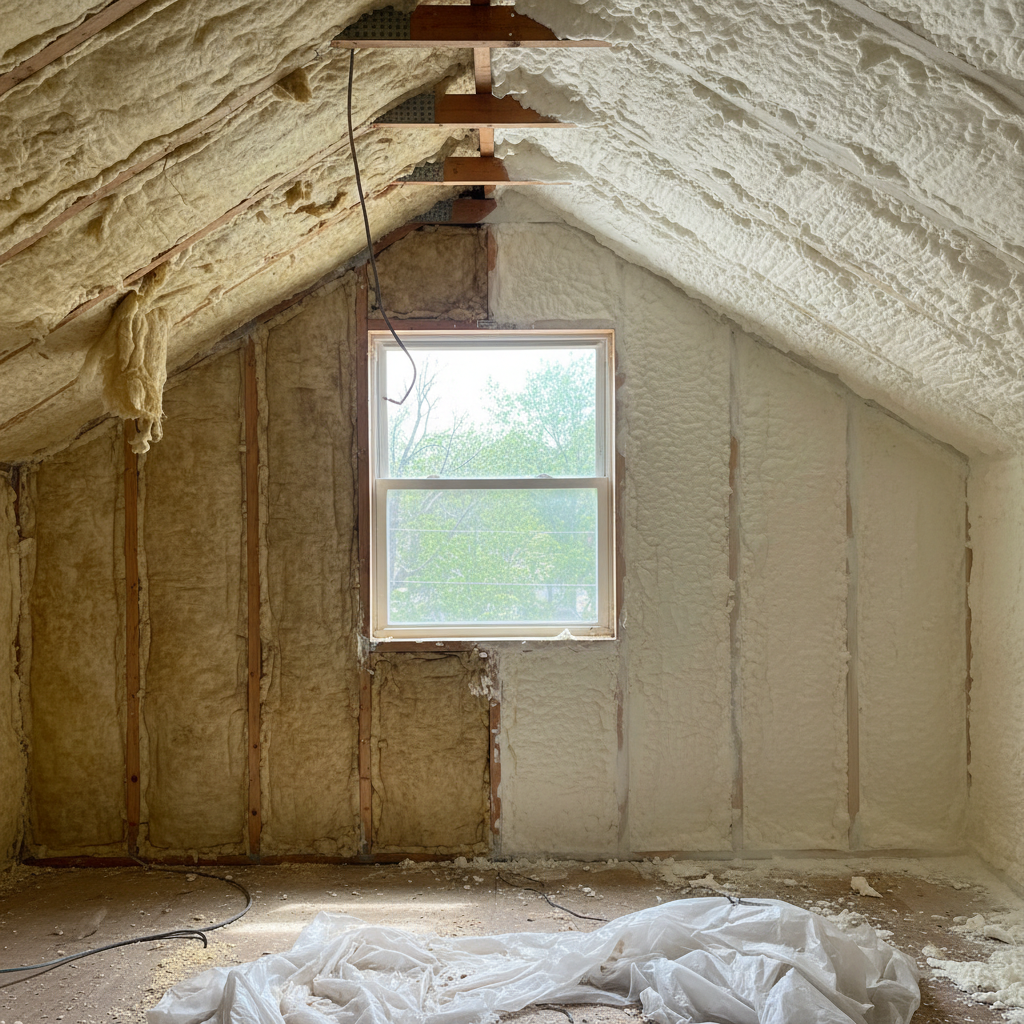
When homeowners are trying to figure out the best way to insulate a house in Arlington Heights, Illinois, they run into choices that can cause confusion. Upgrades involving Open Cell Spray Foam usually come down to two distinct installation methods. Allied Insulation sees this all the time across Arlington Heights, where mid-century colonials and split-levels battle brutal winter freezes and sticky, humid summers. Property owners want to get the best value without creating moisture traps or headaches later on.
Understanding Your Two Main Open Cell Choices
Most contractors will pitch either a full cavity fill or a hybrid approach, sometimes called flash-and-batt or a partial spray. With a full cavity fill, the entire framing space gets blown full of soft, expanding Open Cell Spray Foam. It acts as a very strong air barrier right out of the gate. The second option uses a thinner layer of Open Cell Spray Foam just to seal up the cracks and gaps, then packs the remaining depth with traditional fiberglass batts.
They both use the same core material, but they behave completely differently once they are curing in your walls or roof deck.
Cost and Upfront Investment
Money usually drives the conversation about insulation. The hybrid method costs less upfront. You are buying less Open Cell Spray Foam product, which keeps material expenses down on day one. Allied Insulation knows homeowners like saving money on installation day. But a full cavity fill costs more because you are paying for pure foam depth.
That said, property owners should not just look at the invoice from today. A full fill gives you a solid air barrier that completely stops convective loops. If you go the hybrid route, you are introducing two different materials with different expansion and moisture characteristics. If the cheaper route fails to stop air movement, you will not see the utility savings you expected during a January cold snap in Arlington Heights.
Durability and Long-Term Maintenance
Open cell foam is vapor-permeable. That means moisture can move through it, which is actually a good thing for wood framing in the local Illinois region because it lets the structure dry out if it gets damp. However, durability depends heavily on how well it stays put.
- Full cavity Open Cell Spray Foam locks onto studs and roof decks securely, maintaining its shape for 15 to 20 years or more without sagging.
- Batts used in a hybrid setup can eventually slip, sag, or compress over time, especially in areas experiencing heavy wind vibration or seasonal temperature swings.
- Maintenance is minimal for both once installed properly, but hidden leaks in a hybrid wall can ruin the fiberglass batt without you noticing until mold sets in.
Appearance and Space Management
Neither option leaves much to look at once the drywall or paneling goes up, but during installation, appearance and expansion matter. Open cell expands rapidly. A full fill of Open Cell Spray Foam creates a thick cushion that sometimes needs to be trimmed flush with the studs using a special saw. It is messy work.
The hybrid approach is a bit neater because the Open Cell Spray Foam layer is much thinner, often just an inch or two deep. It leaves plenty of room for standard batts to slide right in front without requiring massive amounts of trimming.
The Local Verdict for Arlington Heights Homes
If you are weighing these two paths for an attic or rim joist upgrade in an established neighborhood like Scarsdale in Arlington Heights, think about where the insulation is going. For attics where you want maximum air sealing to prevent ice dams, a full fill of Open Cell Spray Foam wins hands down. It seals every nook and cranny around complex roof lines where fiberglass batts simply cannot fit.
If you are working on interior walls where sound dampening is your main goal and the exterior already has a solid moisture barrier, the hybrid approach might make sense to keep costs down. But for exterior-facing thermal envelopes battling Illinois weather, skipping corners usually catches up to you. Weigh your long-term energy goals against your immediate budget, and choose the method that keeps your house in Arlington Heights comfortable all year long.